 +34 603 445 673

The new Corrigendum to Regulation (EU) 2023/1545 introduces several updates that directly affect the extended allergen list in the EU. Before exploring what is new, you can revisit our breakdown of the 2023 update here.
This Corrigendum introduces official corrections to improve ingredient accuracy and ensure clear INCI naming, which directly impacts labelling, safety assessments and CPNP submissions. Understanding these adjustments and their deadlines is essential for any cosmetic brand operating in the EU.
Revised Allergen Identifications and What They Mean
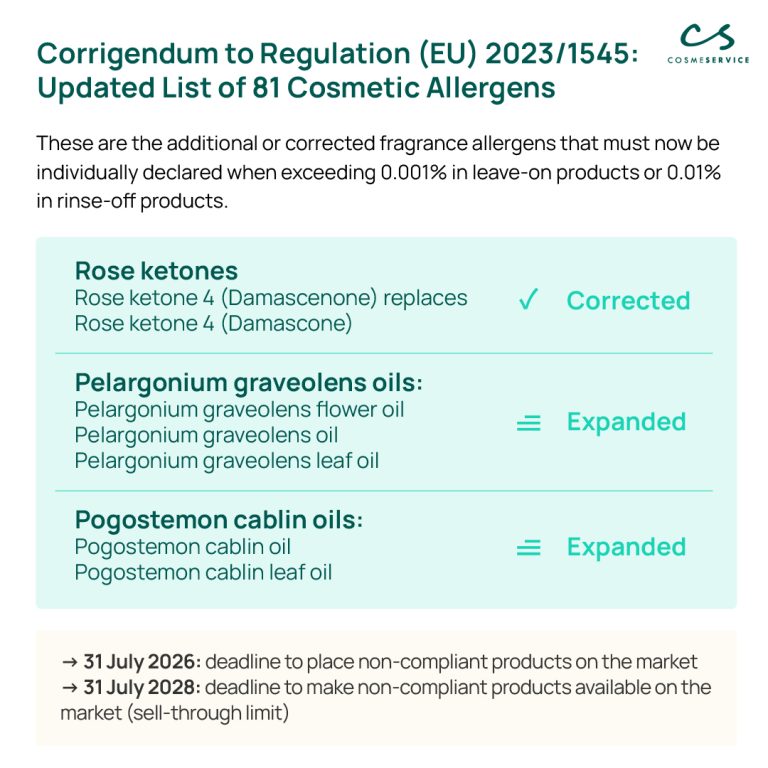
One of the main updates concerns Rose ketones, where the INCI name has been corrected. The previous entry has now been replaced with Rose ketone 4 (Damascenone) to ensure accurate identification of this allergen. This adjustment must be reflected across labelling and safety documentation.
Another relevant change affects Pelargonium Graveolens Oils. The scope has been expanded to include oil, flower oil and leaf oil as ingredients to identify and label as allergens. This broader classification has a direct impact on formulations containing essential oils or natural fragrance compositions, since each fraction must now be declared when thresholds are exceeded.
The Corrigendum also introduces Pogostemon Cablin Leaf Oil as a newly added allergen. Both the oil and the leaf oil must now be declared. This addition increases the relevance of detailed composition analysis for fragrance-rich and natural-origin products.
These updates demonstrate the EU’s continued effort to refine allergen transparency, clarify INCI terminology and reduce ambiguity in natural fragrance material declarations.
Compliance Deadlines and the Actions Required
Even with the publication of the Corrigendum, the original transition deadlines for Regulation (EU) 2023/1545 remain unchanged.
By the 31st of July 2026, products placed on the market must meet the new requirements, and products made available on the market must comply by the 31st of July 2028.
This means that corrected INCI names, expanded entries and new additions must all be implemented within the same regulatory timeline.
For brands with multiple fragrance variations or extensive natural-essential-oil portfolios, early preparation is key. Updating artwork, supplier documentation, CPSR sections and CPNP entries often requires significant coordination between regulatory, formulation and design teams.
How These Updates Affect Daily Compliance Workflows
The Corrigendum may seem technical, but it directly affects ingredient transparency, consumer perception and regulatory consistency. Accurate allergen naming helps avoid compliance gaps, supports clearer communication with safety assessors and ensures products remain aligned with EU expectations.
At the same time, these corrections help streamline future inspections and audits, since INCI terminology is standardised across suppliers and brands, also helping customers to identify the ingredients without any doubt.
Moving Forward with the Updated Allergen Framework
The Corrigendum to Regulation (EU) 2023/1545 provides an important update for cosmetic allergens, including new INCI names, correcting and expanding the entries of the mentioned substances. Understanding what is new and preparing for the upcoming deadlines is essential for any company selling fragrance-containing products in the EU.
Cosmeservice supports brands through every stage of compliance, from formulation checks to documentation reviews and full regulatory implementation.
For support with this update or broader EU cosmetic compliance, our team is available at:info@cosmeservice.com
References
- Official Corrigendum (OJEU)
- Commission Regulation (EU) 2023/1545 of 26 July 2023 amending Regulation (EC) No 1223/2009 of the European Parliament and of the Council as regards labelling of fragrance allergens in cosmetic products.
- Commission Regulation (EC) No 1223/2009 of the European Parliament and of the Council of 30 November 2009 on Cosmetic Products.


